
One of the most common questions drivers ask is: how do I know when my brakes need replacing? It’s not always obvious — and in Dubai, where International City’s narrow internal roads, roundabouts, and constant traffic all put extra demand on your brakes, wear can happen faster than many drivers expect. Knowing what to look, listen, and feel for could save you from a much more expensive repair — or worse, a safety incident on the road.
Dubai International City is home to tens of thousands of residents across its clusters, with constant stop-start driving on the internal roads and heavy use on the nearby Emirates Road and Al Khail Road interchange. Brakes that are used frequently in this kind of traffic wear down considerably faster than brakes on a car used mainly for long highway drives. Most passenger cars in Dubai need a front pad replacement every 25,000 – 40,000 km — but heavy city use can bring that down to 15,000 – 20,000 km.
At Budget Car Buddy, we’re based right here in International City and carry out brake inspections and replacements for residents across the community every week. Our brake pad replacement starts from AED 80 labour. Here’s the complete guide to knowing when it’s time.
Listen: Sounds That Mean Your Brakes Are Worn
Your car will often tell you about brake wear before anything else. These sounds are not normal and should not be ignored:
Squealing or High-Pitched Screeching When Braking
This is the most common early warning sign. Brake pads are manufactured with a small metal wear indicator tab that makes contact with the disc when the pad material wears down to a critical level. The resulting squeal is deliberate — it’s designed to be annoying enough that you don’t ignore it. If you hear a squeal specifically when pressing the brake pedal, your pads are near the end of their life. Book a replacement within the next few days, not weeks.
Grinding, Crunching, or Metallic Scraping
If the squeal has progressed to grinding, the pad material has worn through completely and the metal backing plate is now in contact with the brake disc. This is damaging the disc with every stop. What would have been a pad replacement job is now potentially a disc replacement job too — which costs significantly more. This is urgent. If you can hear grinding, have it inspected immediately and avoid heavy braking until it’s been looked at.
Squealing That Goes Away — Then Comes Back
Some light surface rust on the discs after the car has been parked overnight can cause a brief squeal on the first few stops. This is normal and typically disappears within a few braking applications. If the squeal goes away immediately and doesn’t return during driving, it’s likely surface rust. If it returns consistently during normal braking, it’s the wear indicator.
Feel: What You Notice Through the Pedal and Steering
Brake problems aren’t always audible first — sometimes you feel them through the pedal or the car’s behaviour:
- Longer stopping distances — if the car feels like it needs more road to stop than it used to, braking efficiency has reduced. This is a safety concern that needs prompt attention, not a delay.
- Spongy or soft brake pedal — a pedal that sinks further than normal before the brakes engage usually indicates air in the hydraulic system or low/degraded brake fluid. Can also indicate a failing master cylinder. This needs same-day attention.
- Brake pedal vibrating or pulsating under your foot — this almost always means warped brake discs. Warping occurs when discs overheat and cool unevenly — something that can happen after heavy braking, particularly on the motorway exit into International City during busy periods. Warped discs typically need replacement alongside new pads.
- Car pulling to one side when you brake — if the car drifts left or right specifically when you press the brake pedal, it suggests uneven braking: one side is working harder than the other. This can be caused by uneven pad wear, a stuck or seized caliper, or a brake line issue. Have this inspected immediately — it affects vehicle control in an emergency stop.
- Handbrake not holding the car on a slope — the handbrake operates on the rear brakes. If it no longer holds the car on an incline, the rear pads or handbrake cable may need attention.
See: Visual Checks You Can Do Yourself
You don’t need to be a mechanic to check a few things visually:
- Look through the alloy wheel spokes — on most cars you can see the brake disc and the pad sitting against it. The pad should have visible material on it (ideally more than 3mm). If the pad looks thin or you can see metal against the disc, it’s time for a replacement.
- Check for scoring or grooves on the disc surface — deep grooves or ridges on the disc surface indicate advanced wear, often caused by a pad that’s been left too long. Scored discs need replacing.
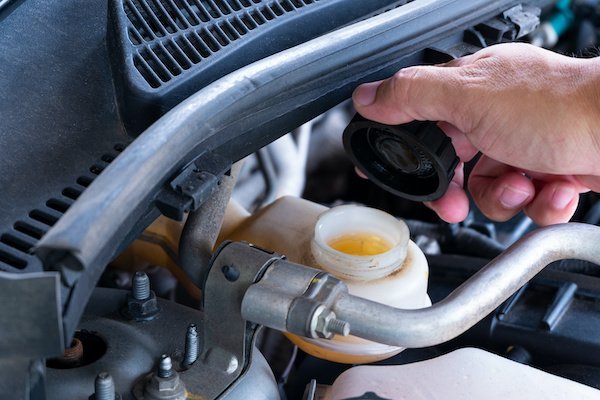
- Check the brake fluid reservoir under the bonnet — the reservoir is usually a small translucent plastic container near the firewall. The fluid level should sit between the MIN and MAX markers. Low fluid can indicate a leak or that the pads are worn down (as pads wear, the caliper extends further and fluid level drops slightly).
- Brake warning light on the dashboard — if the light is red and the handbrake is fully released, check fluid level first. If fluid is fine, this likely indicates a sensor issue or brake system fault. If the light is specifically a pad wear sensor (amber, pad-shaped symbol), the pads are worn.
How Often Should Brakes Be Replaced in Dubai?
There’s no single answer — it depends on your car, your driving style, and how much city driving you do. As a general guide for Dubai conditions:
- Front brake pads: every 20,000 – 40,000 km in Dubai city driving. Heavy traffic use brings this down.
- Rear brake pads: typically last longer than fronts — 40,000 – 60,000 km in many cases, as most braking force goes through the front.
- Brake discs: should last 2–3 pad changes in normal use. Replace when thickness falls below the manufacturer’s minimum or when scoring is deep.
- Brake fluid: change every 2 years or 40,000 km — brake fluid absorbs moisture over time, which lowers its boiling point and can cause brake fade.
Get Your Brakes Checked in International City Today
Now you know how to tell when brakes need replacing in Dubai — and the good news is Budget Car Buddy is right here in International City. We offer mobile brake inspections and pad replacements from AED 80 labour, with an honest assessment of what your car actually needs before we recommend any work. Open every day from 10am to 10pm.
💬 WhatsApp us to book a brake inspection in International City:
+971 50 800 4195
Or book your brake check online.
Other services available in International City and across Dubai:
- Car battery replacement from AED 100
- AC gas refill and repair from AED 80
- Engine oil change from AED 80
- Spark plugs from AED 80 labour
- Alternator repair
Shop 19, Russian W-05, Warsan First, International City, Dubai
Open daily 10am – 10pm | Mobile brake service across International City and all of Dubai
📍 Get Directions on Google Maps